How to rehydrate sourdough starter
Here's how to bring your sourdough starter back to life.
1) Measure a portion of starter
When you're ready to revive the starter, measure out 30 grams or roughly 1/4 cup.
2) Mix the starter with lukewarm water.
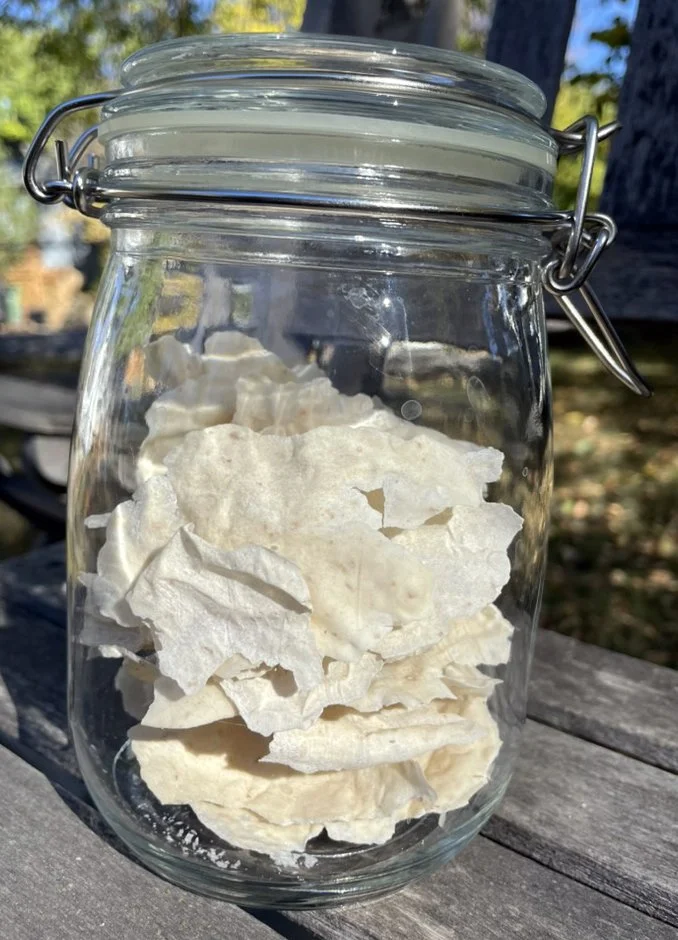
Place the dried starter chips in a large container. Add 30 ml (1/4 cup) of lukewarm water. The water should barely cover the chips; tamp them down, if necessary. Stir the chips/water occasionally; it'll take 3 hours or so, with infrequent attention, to dissolve the chips.
3) Feed the starter with flour.
Once the mixture is fairly smooth/liquid, with perhaps just a couple of small undissolved chips, feed it with 30 grams (1/4 cup) of unbleached all-purpose flour. Mix well. Cover it lightly (I use my beeswax covers for this), and place it somewhere warm. When too cool in the house, you can put it in the oven with the oven light on. Even without ever turning on the heat, it holds a constant temperature around 30°C. You can keep your starter out of the oven, at room temperature; just understand that this whole process might take longer. The cooler the room, the longer it takes sourdough starter to work.
4) Let the starter rest somewhere warm until it bubbles.
Leave the starter for 24 hours. At the end of that time, you should see some bubbles starting to form. Remember, this is at about 30°C; if your temperature is lower, this will take longer. How much longer? Totally depends on temperature. Once you do this process once—in your kitchen, in your climate, accounting for your weather—you'll have a better idea.
5) Feed the starter again.
WITHOUT DISCARDING ANY OF THE STARTER, feed it with 30 ml of lukewarm water, and 30 grams of flour. Cover, and put back in its warm spot. After "X" hours (depends on your kitchen), you should see some serious bubbling; mine was bubbly after just 2 hours, but it could take several hours.
6) Feed Yet again.
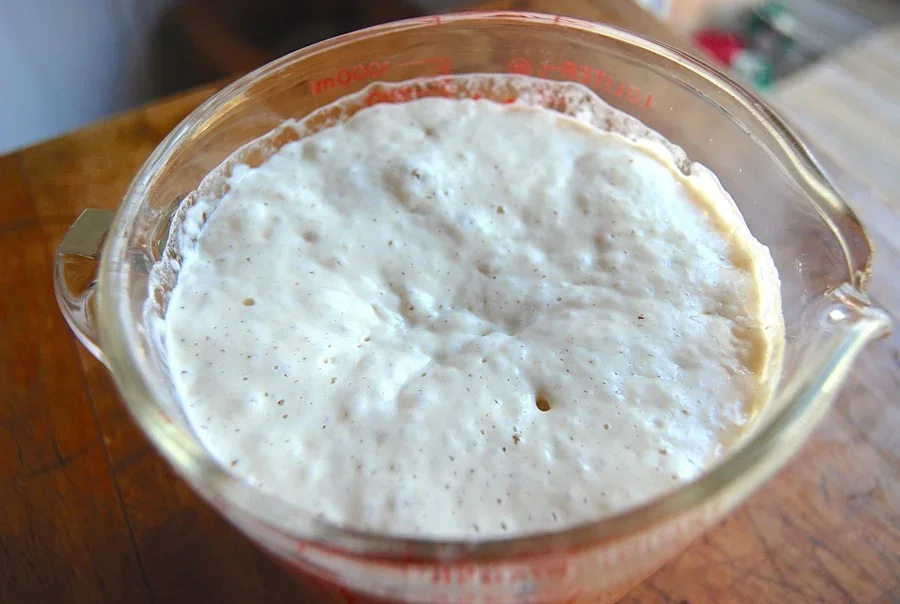
Feed the starter again—30 ml of lukewarm water, and 30 grams of flour—cover, and wait until it bubbles up again. You're not discarding any at this point. It may rise and then fall; this is completely natural.
7) Put the starter back on its regular feeding schedule.
After it’s bubbled up and fallen back a bit, your starter is ready to return to its former life—and its regular schedule. DISCARD all but 113 grams (about 1/2 cup). Feed it once again, this time with 113 grams flour and 113 grams lukewarm water (about 1/2 cup each. You can have a bit more water than flour if you want your starter a bit runnier, which I find easier to work with). This time, it should really expand quickly. If you throw in 10 grams or so of a whole grain flour like rye or whole wheat, it really kicks it into high gear. Mine was triple in size in a couple of hours in a nice warm spot. Your starter is now revived and healthy.
8) At last you're ready to bake!
To ready the starter for baking, feed it again. DISCARD all but 113 grams (about 1/2 cup); and feed the remainder with 113 grams flour and 113 grams lukewarm water. Let it become bubbly (usually doubling in 2 hours or so)—and let the baking begin! You can use a bit less depending on what you need for your recipe. For one loaf, I use 50 grams starter, 50 grams flour, 50 grams water, which is more than sufficient with not much left over. You’ll start to figure out how much you need before you bake as you go along. Check out this traditional recipe or this no-knead recipe.